
EU Packaging Regulations: How to Reduce Packaging Costs and Prepare for PPWR

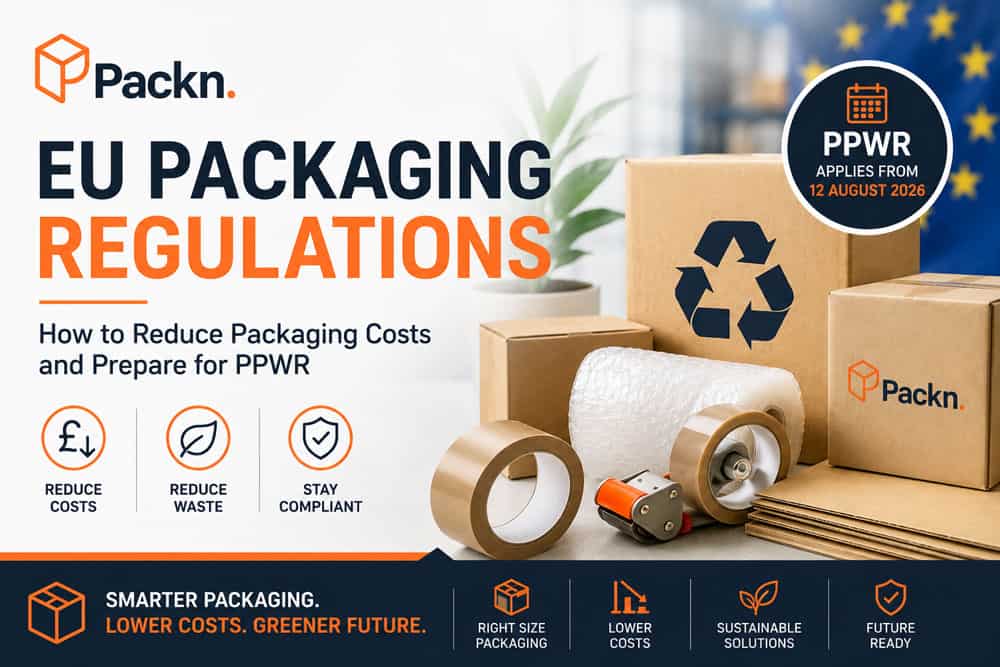
EU packaging regulations are changing how businesses approach packaging across Europe. From 12 August 2026, the EU’s new Packaging and Packaging Waste Regulation (PPWR) will generally apply, bringing greater focus to how packaging is designed, used, recycled and managed.
From 12 August 2026, the EU’s new Packaging and Packaging Waste Regulation (PPWR) will generally apply, bringing greater focus on how packaging is designed, used, recycled and managed.
For businesses, this is not simply another compliance requirement. It is also an opportunity to look at something that directly affects the bottom line: how much packaging you use and how efficiently you use it.
At Packn, we believe that better packaging does not necessarily mean more expensive packaging. In many cases, using the right amount of packaging can help businesses reduce material costs, storage requirements, transport costs and waste at the same time.
What is the EU Packaging and Packaging Waste Regulation?
The Packaging and Packaging Waste Regulation, commonly known as PPWR, is a new EU framework covering packaging and packaging waste.
The regulation is designed to reduce the amount of packaging waste generated, encourage more recyclable packaging, increase the use of recycled materials and reduce unnecessary packaging.
One of the areas particularly relevant to e-commerce is the amount of empty space in delivery packaging. The European Commission says online shops will need to reduce empty space in delivery boxes, supporting the use of smaller and more efficient packaging.
For businesses shipping hundreds or thousands of orders, even a small reduction in packaging can make a significant difference.
How can businesses reduce packaging costs?
1. Use the right-sized box
One of the simplest ways to reduce packaging costs is to stop using boxes that are significantly larger than the products inside them.
Oversized boxes can mean:
- More cardboard per order
- More void fill
- Higher storage requirements
- Greater transport volume
- More packaging waste
A right-sized box can protect the product while using fewer materials.
It can also help businesses make better use of vehicle and warehouse space.
2. Reduce unnecessary void fill
Bubble wrap, paper, air cushions and other protective materials can be essential for certain products. However, using more protective material than necessary can increase costs.
The objective should not be to eliminate protective packaging.
Instead, businesses should ask:
How much protection does this product actually need?
A packaging review can identify where material is essential and where it can potentially be reduced without compromising product protection.
3. Review packaging by product type
Not every product needs the same packaging solution.
A lightweight product may require a completely different packaging approach from a fragile or heavy item.
Creating packaging guidelines based on product size, weight, fragility and shipping requirements can help businesses avoid a one-size-fits-all approach.
This can reduce unnecessary packaging consumption while maintaining protection.
4. Measure packaging used per order
You cannot improve what you do not measure.
One of the most effective ways to prepare for changing packaging requirements is to understand exactly what packaging your business is using.
This can include recording:
- Packaging type
- Material used
- Packaging weight
- Quantity of packaging
- Packaging used per order
- Percentage of different packaging materials
At Packn and UPAC, we are already taking steps in this direction.
We have started developing our own packaging information collection process to help identify the packaging materials and quantities associated with individual orders.
This gives us a clearer picture of the packaging being used and helps us work towards more effective packaging decisions.
5. Consider packaging materials carefully
The PPWR places greater emphasis on recyclability and the use of recycled materials, with the EU aiming for all packaging on the EU market to be recyclable in an economically viable way by 2030.
Businesses should therefore consider not only the price of packaging, but also:
- What material is being used?
- Can it be recycled?
- Is recycled content available?
- Is the packaging unnecessarily complex?
- Can different materials be reduced or removed?
- Can the same packaging perform the job with less material?
The cheapest packaging option at purchase is not always the lowest-cost option overall.
6. Reduce packaging and transport costs together
Packaging decisions can affect more than the packaging budget.
Large or inefficient packaging can increase the volume of goods being transported. Smaller, better-designed packaging can potentially allow businesses to make better use of storage and transport capacity.
That means packaging optimisation can become a logistics optimisation exercise too.
7. Avoid over-packaging
More packaging does not automatically mean better packaging.
The goal should be to use the minimum packaging required to protect the product effectively.
For example, if a product can be safely transported using one appropriately sized box and a suitable amount of protective material, adding multiple unnecessary layers simply increases material consumption and cost.
This is where packaging reviews can provide real value.
PPWR preparation starts with better packaging data
Preparing for PPWR should not begin when a deadline arrives.
It should begin with understanding your current packaging.
At Packn and UPAC, we are already looking at how packaging information can be captured and analysed.
Our new internal packaging information collection process is designed to help us understand the packaging composition associated with orders, including the different packaging materials being used.
This information can help identify opportunities to:
Measure → Analyse → Reduce → Improve
By building better visibility of packaging usage now, businesses can make more informed decisions about packaging design, purchasing and waste reduction.
The opportunity: lower cost, less waste
The PPWR is designed to reduce packaging waste and encourage more efficient packaging systems. The European Commission also notes that using less packaging can save resources, reduce waste-management costs and lower greenhouse-gas emissions.
For businesses, this creates an opportunity to look at packaging differently.
Reducing packaging does not have to mean compromising product protection.
It can mean:
Less material.
Less waste.
Less storage.
More efficient transport.
Better packaging decisions.
And potentially, lower overall packaging costs.
Preparing for the future of packaging
The packaging industry is moving towards greater transparency, better material efficiency and more sustainable packaging solutions.
At Packn, we’re working alongside our customers to understand these changes and help businesses make practical packaging decisions.
Whether you are sending a handful of parcels or managing thousands of orders, reviewing how you package your products today can help you prepare for the requirements of tomorrow.
Better packaging starts with understanding what you use.
And sometimes, the best way to reduce packaging cost is simply to use less of it.
PPWR requirements can vary depending on the type of packaging, product and market involved. Businesses should seek appropriate professional advice when assessing their specific compliance obligations.